Halvorsäng Logistics Park – sustainable logistics dacility aiming for gold


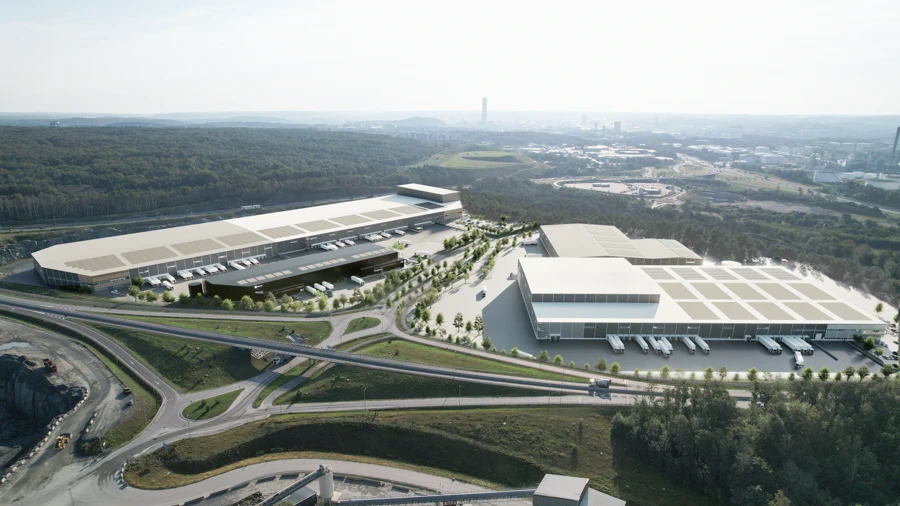
Article summary:
- Halvorsäng Logistics Park is being developed next to the Port of Gothenburg
- The first phase is OneMed’s 45,000 sqm facility
- The goal is Miljöbyggnad v4.0 Gold and alignment with the EU Taxonomy
- Focus on electric transport and smart energy solutions
- Recycled materials reduce the climate footprint
A Logistics project with high ambitions
Halvorsäng Logistics Park is being developed as a future hub for electrified transport flows. Once fully completed, the area will include six facilities and accommodate more than 500 workplaces.
The project is a joint initiative between Castellum and the Port of Gothenburg, where long-term thinking and shared ambitions have been key.
“The key is choosing the right partner when entering a project, and I believe the Port of Gothenburg did that when they chose us. As a long-term property owner, we take a long-term perspective,” says Mats Niklasson, Business Developer at Castellum.
The ambition is clear from the outset: solar panels, battery storage, charging infrastructure, and smart energy management are integrated into the buildings. The first tenant, OneMed, shares this vision.
Top-level environmental certification
The goal is to achieve Miljöbyggnad v4.0 Gold while also meeting the EU Taxonomy’s six environmental objectives, something few, if any, logistics projects in Sweden have accomplished.
“OneMed’s CEO, Peter Nilsson, pushed me hard on achieving Miljöbyggnad v4.0 Gold. ‘Why is it only silver?’ he asked. And I said, it’s very difficult to reach gold. But then we did the calculations and decided to go for it,” says Mats Niklasson.
As part of the certification, 15% of the total 270,000 sqm logistics park will consist of green areas that promote biodiversity, including the creation of a pond for stormwater treatment.
“You get points depending on what you plant. A meadow that becomes a habitat for bees and other species has a higher value than a lawn,” says Mats Niklasson.
Material choices that reduce climate impact
In addition to energy solutions and biodiversity, there is a strong focus on reducing the climate footprint of the construction itself.
“The biggest environmental gains come from two materials that are usually major emitters: concrete and steel. By using a high share of recycled steel and cement blended with silica, we significantly reduce the climate footprint,” says Mats Niklasson.
At the same time, the area is being adapted for electric transport and partial on-site energy production, further strengthening the project’s sustainability profile.
Collaboration driving progress
The collaboration between Castellum and the Port of Gothenburg has been characterised by alignment and a shared focus on long-term goals.
“I feel that we work constructively and supportively. There’s a lot of encouragement and good dialogue at every level, and it has led to positive changes. That’s something we can be proud of,” says Mats Niklasson.
Halvorsäng Logistics Park is thus an example of how collaboration, innovation, and clear ambitions can be translated into the practical development of future logistics.