Stable freight flows at the Port of Gothenburg during the first three quarters of the year


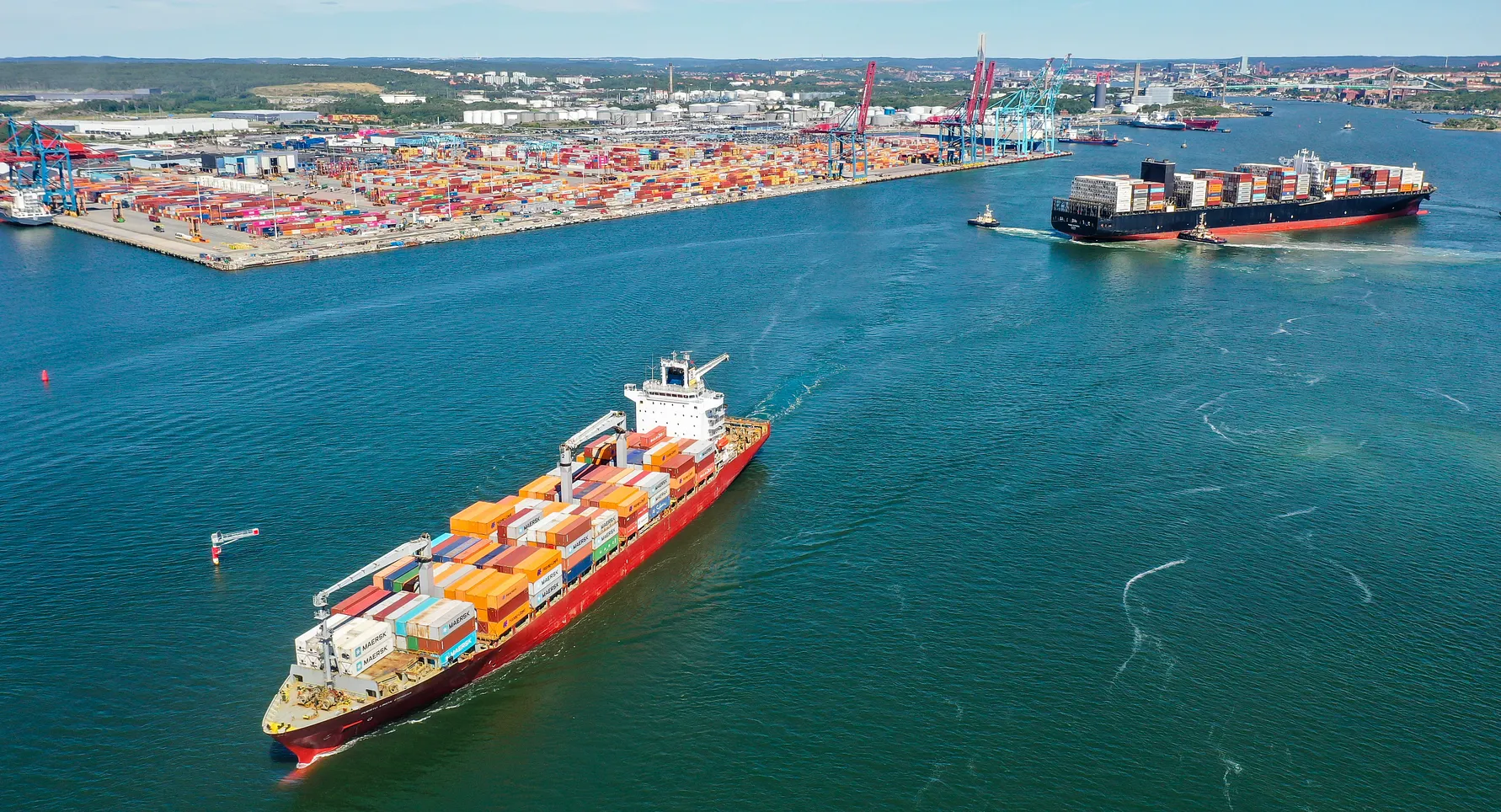
The vessels Puerto Limon Express and Paris Express at the Port of Gothenburg. Photo: The Port of Gothenburg.
Cargo volumes at the Port of Gothenburg developed steadily during January–September 2026. Container volumes remained in line with the previous year, while several segments showed clear growth. New cars increased by 14 percent and energy products by 10 percent. Ro/ro traffic and rail volumes also continued to rise.
In total, 698,000 TEU* were handled at the Port of Gothenburg during the first three quarters of the year, compared with 699,000 TEU during the corresponding period in 2025. Behind the largely unchanged total volume is a 2 percent increase in laden containers, while the handling of empty containers decreased by 11 percent.
Put simply, on the container side, more cargo and less air has been handled compared with the same period last year. Imports of laden containers increased by 7 percent, while exports decreased by 1 percent.
“Overall, we are seeing stable development across all cargo segments in a market situation that remains difficult to assess. Cargo volumes are increasing in all segments, which shows that the port continues to be a strong and reliable freight hub for Swedish foreign trade,” says Claes Sundmark, Vice President Sales & Marketing at the Port of Gothenburg.
Continued strong rail development
Around 60 percent of the containers handled at the Port of Gothenburg are transported by rail to or from the inland, and during the first three quarters of the year rail volumes amounted to 403,000 TEU. This is an increase of 2 percent compared with the corresponding period last year, which means that rail traffic to and from the port is once again heading for a new record year.
“The port’s rail system, Railport Scandinavia, is a crucial part of the port’s offering. It strengthens the competitiveness of Swedish industry by connecting import and export regions across the country with the port’s broad range of maritime services, and doing so in an efficient and sustainable way,” says Claes Sundmark.
Positive development for ro/ro and new cars
Intra-European ro/ro traffic at the Port of Gothenburg consists of truck trailers and other rolling cargo transported on vessels with frequent departures to important logistics hubs in Northern and Central Europe, as well as the United Kingdom. Volumes in the segment increased by 2 percent during January–September and amounted to 405,000 units. Both exports and imports contributed to the increase.
The handling of new cars increased significantly during the period. In total, 197,000 cars were handled, compared with 172,000 during the corresponding period in 2025. This represents an increase of 14 percent. Development was positive on both the export and import side. Exports increased by 10 percent, while imports increased by 29 percent.
Energy products and dry bulk up, stable passenger traffic
Energy volumes also developed strongly during January–September. Exports increased by 15 percent and imports by 4 percent. The total volume increased by 10 percent.
The port’s handling of dry bulk and breakbulk volumes increased by 1 percent to 266,000 tonnes. Growth was driven mainly by pulp, which is handled as breakbulk via the port for onward export in containers.
Passenger traffic overall remained at the same level as the previous year. The number of cruise calls, which tends to fluctuate from year to year, was lower than during the same period in 2025.
Port of Gothenburg throughput, Q1–Q3 2026
Jan-Sept 2026 | Jan-Sept 2025 | % | |
Containers, TEU | 698,000 | 699,000 | 0% |
Rail, TEU | 403,000 | 396,000 | 2% |
Ro/ro units | 405,000 | 396,000 | 2% |
New cars | 197,000 | 172,000 | 14% |
Energy prod. (m tonnes) | 16,5 | 15,1 | 10% |
Cruise calls | 40 | 55 | -27% |
Passengers | 1,140,000 | 1,146,000 | 0% |
Dry bulk (tonnes) | 266,000 | 264,000 | 1% |
*One TEU, twenty-foot equivalent unit, corresponds to one twenty-foot container.