Progress in onshore power supply for vessels


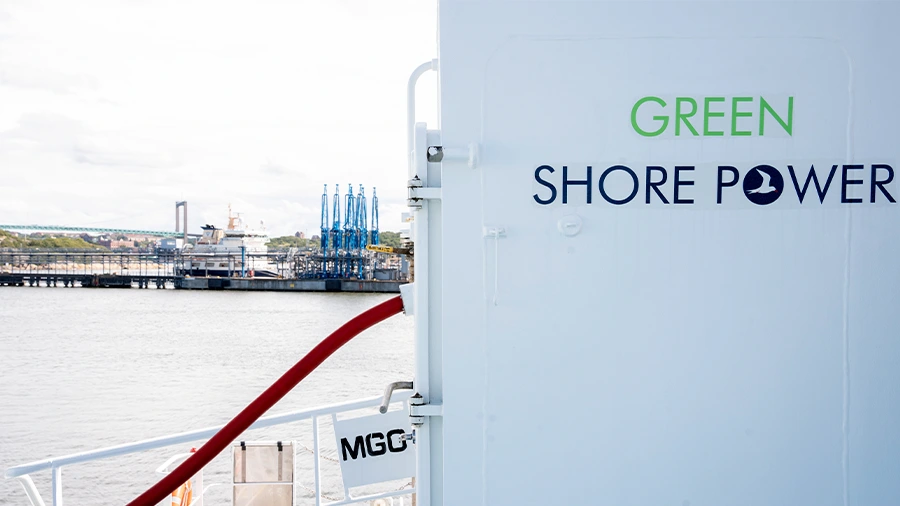
A key part of reducing the climate impact of shipping
Onshore power is a key part of reducing the climate impact of shipping. When vessels can connect to the electrical grid at berth, the need for auxiliary engines powered by marine diesel is eliminated. This reduces emissions of carbon dioxide, nitrogen oxides, sulphur oxides, and particulate matter, while also lowering noise levels in the port area.
Expansion is progressing in line with both regulatory requirements and demand. Skandia Port is set to be connected by 2030, while Älvsborg Port is being developed to meet the needs of shipping companies.
During 2025, several important steps have been taken. Älvsborg Port has moved from concept study to detailed design, and construction of a grid station and switchgear has begun in Skandia Port. The Port of Gothenburg has also contributed to the development of international guidelines for onshore power connections for tankers, helping to accelerate global implementation.
At the same time, analyses are underway for future expansion, including in the Energy Port. A pilot project with several partners has also demonstrated that green hydrogen can serve as a zero-emission alternative for power supply where onshore infrastructure is not available.
Development faces challenges such as varying vessel technologies, short contract periods, and the need for coordination between shipping companies. At the same time, technical maturity and demand are increasing as more vessels are equipped for onshore power.
Alternative fuels and energy efficiency drive progress
Alongside electrification, the Port of Gothenburg is taking steps to become a leading bunkering hub for renewable fuels in Scandinavia. Together with partners, investments are being made to strengthen access to fossil-free alternatives for both shipping and industry.
Nordion Energi’s liquefaction plant for biogas is expected to be operational in 2026. It will be the first with a direct connection to the West Swedish gas grid and will supply approximately 250 GWh of liquefied biomethane annually. At the same time, St1 Biokraft has completed the first bunkering of Swedish-produced liquefied biogas in the port, demonstrating that biomethane can be used at scale.
Within shipping, there is also a clear trend of increasing energy efficiency measures onboard vessels. This enables significant reductions in carbon emissions without changing fuel.
One example is Furetank, which in 2025 secured fossil-free operations for its EU-based fleet, partly through the use of biogas and HVO100 bunkered in the Port of Gothenburg.
How does the Port of Gothenburg reduce emissions from shipping?
- Around 80% of Scope 3 emissions come from customers’ vessels
- Onshore power eliminates emissions at berth
- Investments in fossil-free fuels and energy efficiency are increasing
- Several concrete projects are driving progress
The transition of shipping is not driven by a single solution. Instead, it is the combination of onshore power, alternative fuels, and energy efficiency that together reduces overall climate impact.
By building a robust energy infrastructure, the Port of Gothenburg creates the conditions for both emission reductions and a competitive development of shipping while strengthening its role as a key hub in the energy transition of industry.