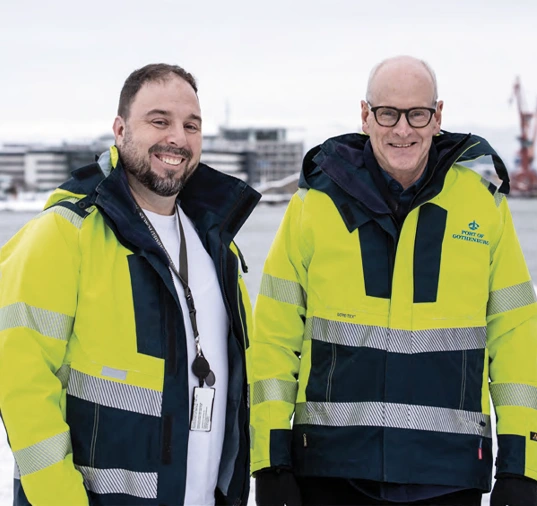
Social sustainability in port operations is about people, safety, and responsibility. By focusing on the work environment, inclusion, and skills development, the Port of Gothenburg creates the conditions for a safe workplace and a resilient operation in a changing world.
Health, safety, and inclusion
The Port of Gothenburg operates in an environment with high demands on safety, competence, and collaboration. Employees’ health, safety, and working conditions are therefore crucial, both for individuals and for ensuring that port operations run safely and efficiently over time. Shortcomings in the work environment or equal treatment pose risks to both people and operational stability.
Work in the port is partly carried out in high-security environments with complex tasks. This involves risks related to both physical and mental health, such as heavy lifting, vehicle traffic, noise, shift work, stress, and the need for recovery. At the same time, there are challenges related to skills supply, as the operations require specialised expertise in areas such as safety, technology, energy transition, and maritime professions.
85-90
HME (Sustainable Employee Engagement) measures motivation, leadership, and governance in the workplace. The Port of Gothenburg aims for an HME score of 85–90.
85-90
HME (Sustainable Employee Engagement) measures motivation, leadership, and governance in the workplace. The Port of Gothenburg aims for an HME score of 85–90.
0%
HME (Sustainable Employee Engagement) measures motivation, leadership, and governance in the workplace. The Port of Gothenburg aims for an HME score of 85–90.
0%
HME (Sustainable Employee Engagement) measures motivation, leadership, and governance in the workplace. The Port of Gothenburg aims for an HME score of 85–90.
How we create a safe and inclusive workplace
The Port of Gothenburg aims to be an inclusive employer where everyone is treated fairly and with respect. The company upholds human rights and works to provide a safe, secure, and supportive work environment, regardless of role, function, or workplace.
The work environment approach covers both physical and organisational aspects, with a focus on preventive safety measures, clear procedures, and leadership that takes responsibility for both workload and well-being. To counter discrimination and unequal conditions, the Port of Gothenburg actively promotes inclusion, transparent processes for recruitment and development, and values-driven leadership.
Skills development, internal career paths, and strong employment conditions are key elements in attracting, retaining, and developing the right competencies over time.
Inner strength drives external change
The Port of Gothenburg invests in developing employees’ inner capabilities through the research-based framework Inner Development Goals (IDG). The aim is to strengthen both individuals and the organisation’s ability to navigate a changing world.
The programme focuses on self-leadership, reflection, and collaboration, providing new tools for both work and everyday life.
“You are never fully developed, and this gives me a chance to learn new things about myself and the people I work with,” says Erik Hallgren. He highlights how a shared mindset has made it easier to open up to colleagues he didn’t know as well.
“The more you learn, the more you realise how little you know,” says Carl Jansson, noting that the programme has given him both new insights and practical tools to handle situations in both his personal and professional life.
The initiative runs over a longer period than traditional training programmes, creating the conditions for real change. The ambition is for all employees to take part, with strengthened self-leadership contributing to an even more resilient and forward-looking organisation.